
The Impeachment Process in the Philippines (2025): A Brief Legal Overview


Understanding how Philippine Impeachment Proceedings in 2025 has never been more relevant today with the current news on the impeachment attempts against Vice President Sara Duterte. This political process exists to maintain accountability & integrity in the most important positions in the Philippine government. And because of its importance, it is also understandably complex.
This article thus seeks to give an easy-to-follow overview of the impeachment proceedings and which stage/s sparks much controversy within the professional and political atmosphere today.
What is Impeachment & Who Can Be Impeached in the Philippines?
Impeachment proceedings refer to “the power of Congress to remove a public official for serious crimes or misconduct” (Corona v. Senate (2012)). The legal provisions which provide for such a mechanism are embedded in the 1987 Constitution, particularly Article XI.
Section 2 of Article XI gives us a list of public officers subject to impeachment:
-
President
-
Vice-President
-
Members of the Supreme Court
-
Members of the Constitutional Commissions (i.e. the Civil Service Commission (CSC), Commission on Elections (COMELEC), and Commission on Audit (COA))
-
Ombudsman
This list is exclusive since the section also states that all other public officials may be removed from office other than impeachment “as provided for by other provisions of law”.
Grounds for Impeachment Under the 1987 Constitution
In the same section, Section 2 of Article XI, the grounds for impeachment are listed as follows:
-
Culpable Violation of the Constitution
-
Treason
-
Bribery
-
Graft and Corruption
-
Other high crimes, or
-
Betrayal of Public Trust
Since it is not yet clear as to what makes these grounds convincing when it proceeds to trial, the 2012 case of former Chief Justice Renato Corona is informative on the kind of evidence needed to prove the alleged grounds. The senator-judges during the impeachment trial stated that the proceedings will decide on a “quantum of evidence” instead of on “guilt beyond reasonable doubt”.
How do impeachment proceedings begin?
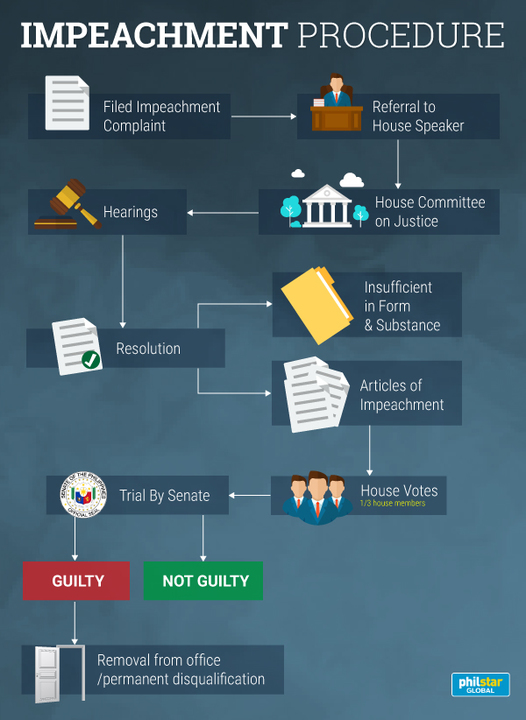
Under Section 3, Article XI of the 1987 Constitution, the House of Representatives (or the “HREP”) has the exclusive power to initiate impeachment. Proceedings may begin through:
-
Filing of a verified complaint for impeachment by any Member of the House of Representatives.
-
Filing of a verified complaint for impeachment by any citizen upon resolution of endorsement by any Member thereof
-
Filing of at least one-third (⅓ ) of all the Members of the House of Representatives of a verified complaint or resolution of impeachment is filed by at least one-third of all the Members of the House
This particular step of the proceedings is a critical one since this sparks the current controversy on the application of the one-year bar rule.
The One-Year Bar Rule (2025 Supreme Court Ruling)
The Constitution has put up limitations on the power to impeach however and one of these is the one-year bar rule. This means that “no impeachment proceedings shall be initiated against the same official more than once within a period of one year.” (Section 3, paragraph 5 of Article XI).
In Duterte v. HOR (2025), the Supreme Court clarified that the one-year bar shall commence “from the time an impeachment complaint is dismissed or no longer viable.”
In this case that ignites debate within and outside the legal community, there were a total of four (4) impeachment attempts against VP Duterte but since the 3 impeachment complaints were archived and therefore deemed terminated or dismissed on February 5, 2025, no new impeachment complaint, may be initiated earlier than February 6, 2026.
What happens after the impeachment proceedings begin?
After a verified complaint has been filed through the abovelisted ways, the complaint must be included in the Order of Business (or in other words, agenda) within ten (10) session days and referred to the proper House committee within three (3) session days pursuant to Section 3, paragraph 2 of the same Article.
A hearing shall be conducted where the committee members will either vote in favor of the Articles of Impeachment or the document containing the allegations against the public officer to be impeached or override it before the case proceeds to trial.
What happens at the impeachment trials?
This approved resolution or Articles of Impeachment shall be transmitted to the Senate for the trial. The Senate, pursuant to their Rules, shall receive evidence and hear testimonies from the accused, much like in a criminal court proceeding.

What happens to an impeached public official?
After the determination of the guilt of the accused of the acts stated in the Articles of Impeachment, the accused is convicted & removed from office.
Conviction & removal from office however does not automatically mean that the removed officer may not be held accountable before other civil courts or tribunals. What it does entail however is perpetual disqualification from serving in office after such “conviction”. He/she may no longer be elected for any position that may be voted upon by citizens of the country.
Tip: If you want to explore more about the Philippine impeachment proceedings beyond this overview, easy legal research can now be done through Digest.ph.
Key Takeaways
-
Philippine impeachment proceedings is a very important process today due to the recent Supreme Court ruling on the impeachment attempts against VP Duterte.
-
There are three (3) main steps in the impeachment proceedings: initiation, approval or rejection of the Articles of Impeachment, and trial.
-
The accused, when convicted and removed from office, may no longer be elected for any position that may be voted upon by citizens of the country.
-
Impeachment proceedings against VP Sara Duterte may not be initiated before February 06, 2026.
Frequently Asked Questions (FAQs)
What kind of proceeding is impeachment?
An impeachment proceeding is sui generis or “a class of its own.” This means that impeachment proceedings cannot be classified as civil or criminal. Rules applicable to these legal fields do not regularly apply to impeachment proceedings.
What happens when you are impeached?
When one is convicted after the impeachment trial, he/she is removed from office and shall suffer perpetual disqualification from serving in an elected position.
What’s the difference between quo warranto proceedings & impeachment?
Quo warranto is a legal remedy to determine a person's right or title to a public office and to oust the initial holder. It challenges a public officer's eligibility or the validity of his/her appointment (Republic v. Sereno).
Impeachment on the other hand focuses on the misconduct committed by a public official while he/she is in office.
Conclusion
While it is a highly technical procedure, it is not impossible to learn even for non-law student/lawyers. This quick overview of the impeachment proceedings in the Philippines is very helpful in cutting up this seemingly long process into smaller, bite-sized steps.