
What is a CPA Lawyer? Role, Salary, and Career Path in the Philippines


A career in law and accounting is both prestigious and highly regarded in the Philippines, but what happens when these two fields merge? The result is a CPA Lawyer—a professional who is both a Certified Public Accountant (CPA) and a licensed lawyer. This rare combination provides expertise in both legal and financial matters, making CPA Lawyers highly sought after in corporate, tax, and financial law. For those considering this dual career path, this guide covers everything you need to know.
What does CPA mean in law?
In law, CPA stands for Certified Public Accountant. A CPA is someone who has successfully passed the CPA licensure examination and is recognized as an expert in accounting, taxation, auditing, and finance. When combined with a law degree, this expertise makes a CPA Lawyer a highly valuable asset in corporate, tax, and financial legal matters.
Is CPA higher than an accountant?
Yes, a CPA is a higher qualification than a regular accountant. While an accountant may handle basic financial tasks such as bookkeeping, financial reporting, and compliance, a CPA has additional qualifications and certifications that allow them to perform audits, financial analysis, and legal tax consultations.
What is a CPA Lawyer?
A CPA Lawyer is a professional who has passed both the Certified Public Accountant (CPA) board exam and the Philippine Bar Exam, allowing them to practice as both an accountant and a lawyer. This unique combination enables CPA Lawyers to handle financial, corporate, and tax-related legal issues with expertise.
Role and Responsibilities of a CPA Lawyer
A CPA Lawyer in the Philippines performs a wide range of functions that bridge the fields of accounting and law. These professionals are often employed in law firms, accounting firms, corporations, and government agencies.
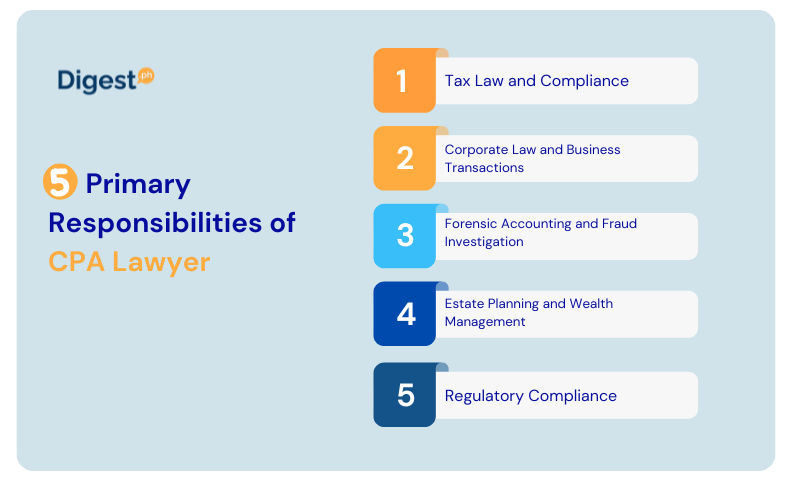
Here are some of their primary responsibilities:
-
Tax Law and Compliance – Assisting individuals and businesses in tax planning, tax audits, and dispute resolution with the Bureau of Internal Revenue (BIR).
-
Corporate Law and Business Transactions – Handling mergers, acquisitions, corporate restructuring, and financial agreements.
-
Forensic Accounting and Fraud Investigation – Investigating financial crimes such as embezzlement, fraud, and money laundering.
-
Estate Planning and Wealth Management – Advising clients on estate tax, trust funds, and asset management.
-
Regulatory Compliance – Ensuring companies comply with financial and corporate regulations, including SEC, BIR, and other governing bodies.
A CPA Lawyer's dual expertise makes them highly valuable for businesses that require both legal and financial advice in one professional.
Salary and Earning Potential of a CPA Lawyer in the Philippines
One of the biggest advantages of becoming a CPA Lawyer is the high earning potential. The combination of both accounting and legal expertise significantly boosts salary expectations.
How much does a CPA Lawyer earn?
The salary of a CPA Lawyer in the Philippines depends on experience, employer, and area of specialization. A quick look at different job application sites would reveal the following general breakdown:
-
Entry-Level CPA Lawyer: PHP 50,000 – PHP 80,000 per month
-
Mid-Level CPA Lawyer (5+ years experience): PHP 100,000 – PHP 200,000 per month
-
Senior CPA Lawyer / Partner-Level: PHP 250,000+ per month
Corporate executives, law firm partners, and government officials with CPA Lawyer qualifications often earn millions annually, especially if they specialize in taxation and corporate law.
Which is Harder: CPA or Law?
One of the most frequently asked questions is whether becoming a CPA is harder than becoming a lawyer.
Is CPA hard in the Philippines?
Yes, the CPA Licensure Exam is extremely difficult, with passing rates ranging from 10% to 30%. It requires strong analytical skills and deep knowledge of taxation, financial reporting, and auditing.
Which is harder, law or CPA?
It depends on individual strengths. The CPA exam focuses on mathematical and analytical skills, while law school and the Bar Exam require strong critical thinking, legal interpretation, and extensive memorization. Many professionals believe that law school is more time-consuming, while the CPA exam is more technical.
For those who pursue both, the challenge is significantly greater but also more rewarding.
The Future of CPA Lawyers in the Philippines
With increasing business regulations and tax complexities, the demand for CPA Lawyers is on the rise. Many multinational companies, auditing firms, and government agencies prefer hiring professionals with dual expertise to handle legal and financial matters efficiently.
Additionally, CPA Lawyers can establish their own legal and financial consultancy firms, offering services such as tax litigation, financial compliance, and corporate advisory.
Conclusion
Becoming a CPA Lawyer in the Philippines is a challenging yet rewarding career path. It requires years of study, passing both the CPA Licensure Exam and the Philippine Bar Exam, and gaining expertise in both law and accounting.
The earning potential for CPA Lawyers is significantly higher than that of regular accountants or lawyers, making it an excellent career choice for those willing to put in the effort. With expertise in corporate law, taxation, and financial regulations, CPA Lawyers play a crucial role in business and legal industries.
If you are passionate about both accounting and law, pursuing a CPA Lawyer career is one of the most prestigious and financially rewarding paths you can take in the Philippines.
FAQs Regarding CPA Lawyers
-
How to Become a CPA Lawyer:
-
Education: You need to complete a bachelor's degree, preferably in accounting or a related field, and then earn a Juris Doctor (JD) degree from an accredited law school.
-
CPA Exam: Pass the Uniform CPA Exam to become a licensed CPA.
-
Bar Exam: Pass the bar exam to become a licensed attorney.
-
Experience: You may need to gain experience in both accounting and law to further develop your skills and knowledge.
-
-
Areas of Specialization:
-
Tax Law: CPA Lawyers often specialize in tax law, advising clients on complex tax matters and helping them navigate tax regulations.
-
Corporate Law: They can also specialize in corporate law, advising businesses on legal and financial issues.
-
Estate Planning: Their combined expertise can be valuable in estate planning, helping clients create wills and trusts that are both legally sound and financially efficient.
-
Other areas: Depending on their interests and skills, CPA Lawyers can also work in areas like bankruptcy law, securities law, and real estate law.
-

Check out our Collection of Free Case Digests!
At Digest.PH, we understand the importance of quality resources for legal research and education. That's why we offer a curated collection of free legal case digests, meticulously selected to aid practitioners, scholars, and students in their pursuit of legal knowledge. Explore our repository today and empower yourself with essential insights into the world of law!
With access to reliable sources and online platforms, conducting thorough research has never been easier. Elevate your understanding of the law today with the help of the best legal research in the Philippines!